
Therapy and Well Being
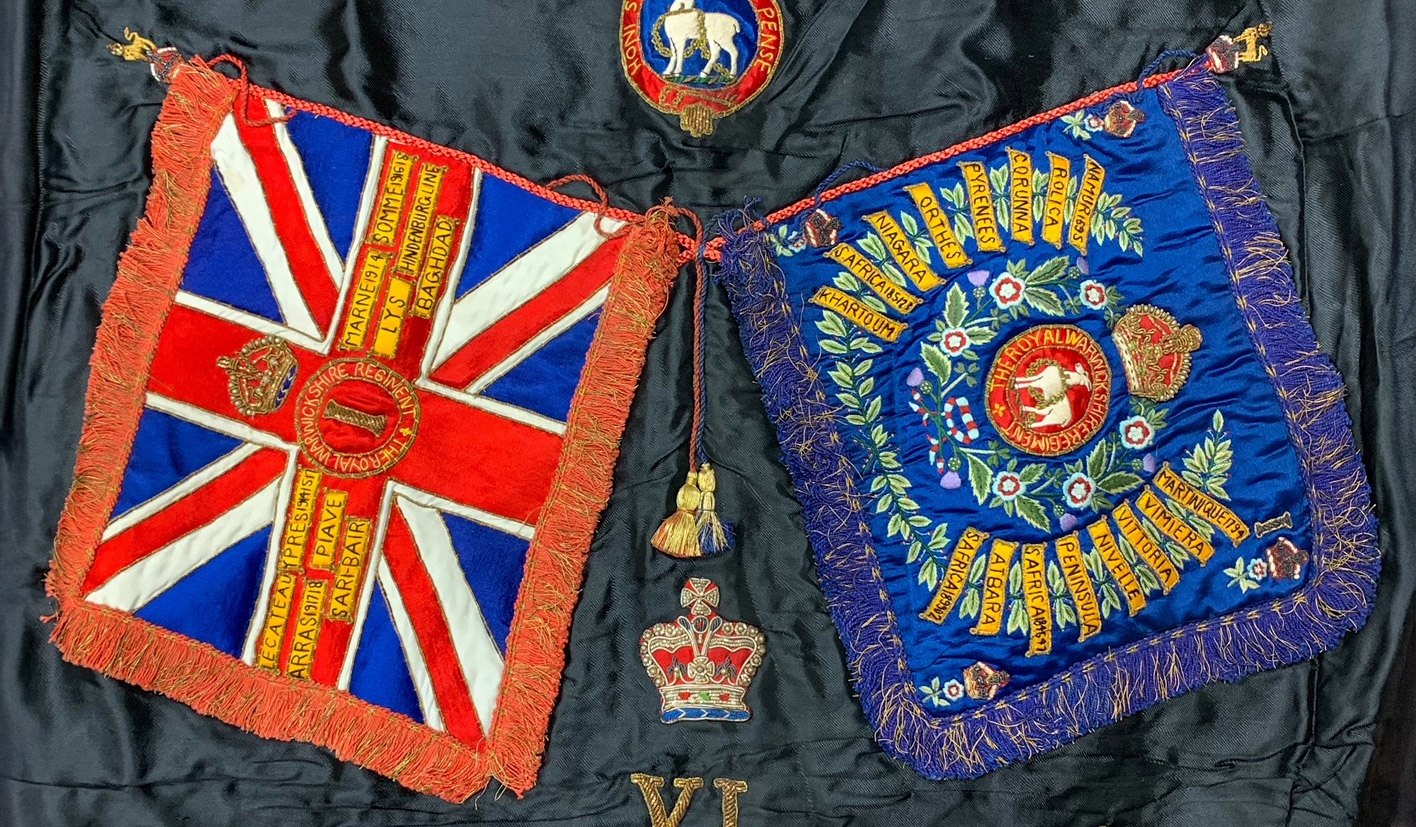
Of the two million combatants in the First World War who were injured, a quarter experienced life-changing injuries and never returned to the frontline. The more severely injured were returned to hospitals in Britain where being confined to bed for extended periods and what we now recognise as Post Traumatic Stress Disorder (PTSD) greatly affected their mental wellbeing. It was generally understood that providing activities for these long-term sick soldiers was beneficial. Embroidery was seen as ideal: it was a quiet activity that could be done anywhere alone or in groups, and it required mental focus to achieve a satisfying result.
Lady Olive Smith-Dorrien D.B.E.
Lady Olive Smith-Dorrien D.B.E. (1881-1951), then the Principal of the Royal School of Needlework, led a group of female volunteers, ‘practical needle women’ with patience and enthusiasm, to support craft activities for injured soldiers to aid peace of mind which was seen as essential to recovery. In an article “On Teaching Convalescents” Lady Smith-Dorrien records that within the first few months of the war there was public recognition of the benefit in setting up ‘handicraft centres’ in hospitals where long-term injured servicemen resided. She stressed the value of embroidery rather than knitting, a more mechanical activity requiring less focus. She instructed her volunteers that:
‘Your first task must be to prove to your patient that needlework is not derogatory to his manhood – Make him understand that thousands of able-bodied men all over England who work hard all day with their brains have, during the last ten years or so, realise that stitching away in the evenings is the very best way of resting their over-tired nerves’.
Ernest Thesiger
Lady Smith-Dorrien noted many men had become expert embroiderers. Ernest Thesiger (1879-1961) realised the economic potential of this expertise and in 1918 he founded ‘The Disabled Soldiers’ Embroidery Industry’ to provide a means for injured soldiers to earn an income from embroidery skills. Ernest was a famous actor on stage and screen. In 1915 he was wounded while serving in the 9th London Battalion (Queen Victoria’s Rifles). In hospital he saw wounded soldiers doing embroidery and became intrigued. Drawing on his own interest in antique furniture he persuaded disabled soldiers, who were incapable of doing any other work, to stitch articles such as chair covers to restore furniture, and create altar frontals and ecclesiastical vestments. The DSEI had Royal Patronage and eventually received commissions from both the UK and abroad.
Louisa Pesel
Louisa Pesel (1870 – 1947) studied decorative stitchery at the Royal College of Art, won awards for her work and became the Director of the Royal Hellenic School of Needlework and Laces. She helped to found what later became the Embroiderer’s Guild. In the First World War, Louisa worked with the Bradford Khaki Handicraft Club for shell-shocked soldiers. In 1920, she became President of the Embroiderers Guild and in the Second World War was involved in assembling embroidery kits for prisoners of war which the Red Cross then distributed.
By the Second World War, stitching kits with transfer paper stamped with templates of regimental badges were ordered by the War Office for each regiment to provide therapeutic activities for injured soldiers.
Artefacts

With a design showing a regimental garter badge, this may have been a therapy piece.. view more


short intro. view more


